
Marketing
Checks positioning, audience clarity, campaign fit and tone.
Event content review and approval is the human sign-off layer inside Event Growth Studio, not the AI drafting assistant or the publishing button. It helps organisers protect accuracy, brand confidence and operational trust before selected pages are published.
Structured for discovery. Assisted by AI. Approved by your team.
Conceptual workflow
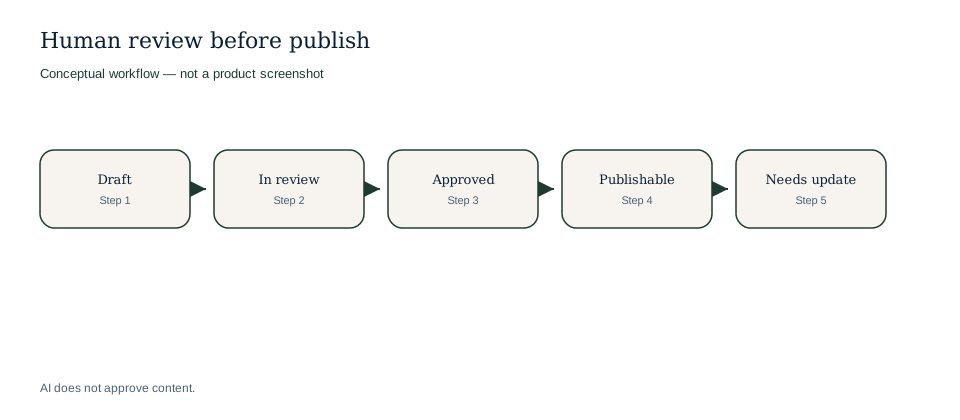
Human sign-off remains the publication gate.
Conceptual workflow
Conceptual workflow. AI does not approve content.
Review status is handled page by page so teams can control a complete event guide as facts, programmes and partners change.
A page or section is created from purpose-built templates, source material and AI assistance.
Owners check claims, tone, source accuracy, legal or sponsor requirements and operational details.
The page is cleared for publication but has not necessarily been released yet.
The approved page is made public while other pages can remain in draft or review.
Stale facts, changed programmes or new ticket information can send content back into review.
Example only: a reviewer can approve, hold or send content back based on the evidence available.
| Page section | Reason to hold | Human decision before publish |
|---|---|---|
| Ticket guidance says early-bird pricing ends Friday. | Ticketing source has not confirmed current availability. | Hold the section until the ticketing owner confirms wording. |
| Speaker profile uses a submitted biography. | Speaker title changed in a later programme note. | Edit the profile and return it to review. |
| Venue access FAQ references Gate B step-free entry. | Operations note is current and source owner is listed. | Approve the FAQ for preview and publishing. |
Page section
Ticket guidance says early-bird pricing ends Friday.
Reason to hold
Ticketing source has not confirmed current availability.
Human decision before publish
Hold the section until the ticketing owner confirms wording.
Page section
Speaker profile uses a submitted biography.
Reason to hold
Speaker title changed in a later programme note.
Human decision before publish
Edit the profile and return it to review.
Page section
Venue access FAQ references Gate B step-free entry.
Reason to hold
Operations note is current and source owner is listed.
Human decision before publish
Approve the FAQ for preview and publishing.
Event guide content often needs more than one reviewer because different teams own different facts, promises and risks.
Checks positioning, audience clarity, campaign fit and tone.
Checks timings, venue details, access information and practical visitor guidance.
Confirm that ticket references align with canonical read-only ticket facts.
Approve submitted descriptions, directory entries, Media Kit details, rights, credits and brand-sensitive content.
AI can help draft, rewrite and adapt guide sections, but it cannot approve or publish a page. Reviewers remain responsible for checking source evidence, commercial claims, compliance needs and operational facts before a page moves toward publication.
A complete digital event guide rarely becomes ready all at once.
Review and approval connects source-backed drafting to the public microsite and later discovery outputs.
Explore connected Event Growth Studio workflows without leaving the creation and CMS cluster.
No. AI can assist drafting, but approval and publication require human control.
Yes. A complete digital event guide can contain draft, in-review, approved and published pages at the same time.
The team that owns ticketing or commerce should confirm references against canonical read-only ticket facts.
Yes. Changed programmes, stale sources or operational updates can require a new review before publication or republishing.
No. Review improves control and accuracy, but it does not guarantee sales, rankings, rich results or AI citations.
Check operational facts, partner commitments, ticket references and audience claims before pages go live.
Use review state alongside microsite preview so approved pages can launch while weaker pages stay private.
Keep the wider event-site, discoverability and promotion workflow grounded in the same approved event record.
Drafts stay drafts.
Humans own the publication gate.