
Thin event listing
- Visitors get one summary page with limited detail.
- Timings, sessions or acts often stay buried in PDFs or attachments.
- Search and AI systems see weaker context for specific programme questions.
The event programme builder is a page-family proof route inside Event Growth Studio. It shows how a governed digital event guide can turn approved schedule and programme information into public pages that help visitors understand what happens, when it happens and what to explore next.
Structured for discovery. Assisted by AI. Approved by your team.
Conceptual workflow
Programme pages derive from approved schedule and event context.
Conceptual workflow
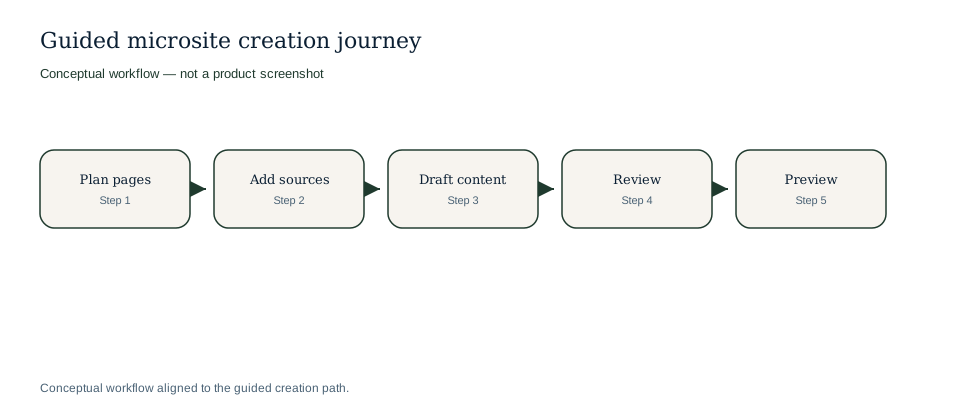
Conceptual workflow for programme and schedule page proof.
A thin event listing rarely answers the real visitor question: what is happening, when should I attend, and what else should I plan around it? Event Growth Studio treats programme pages as a defined event-guide page family rather than a pasted timetable block inside generic marketing copy.
Example only: a programme page can organise approved event information like this before publication.
| Approved source | Public page can explain | Human review still checks |
|---|---|---|
| Session titles, times and room names. | What happens in each session and when visitors should attend. | Final timing accuracy and room changes. |
| Artist stage times and day-by-day running order. | How the line-up fits together across the event. | Current stage assignment and appearance status. |
| Workshop notes and audience-level guidance. | What the experience includes and who it suits. | Capacity wording, inclusion claims and operational fit. |
Approved source
Session titles, times and room names.
Public page can explain
What happens in each session and when visitors should attend.
Human review still checks
Final timing accuracy and room changes.
Approved source
Artist stage times and day-by-day running order.
Public page can explain
How the line-up fits together across the event.
Human review still checks
Current stage assignment and appearance status.
Approved source
Workshop notes and audience-level guidance.
Public page can explain
What the experience includes and who it suits.
Human review still checks
Capacity wording, inclusion claims and operational fit.
Explore connected Event Growth Studio workflows without leaving the creation and CMS cluster.
No. This route sells a public-facing event-guide page family for programme and schedule information, not internal production scheduling or show-control tooling.
Yes, but changed times or locations should move back through review so public pages stay accurate.
Yes. That connection is part of the value: visitors can move between what is happening and who is involved.
No. Programme pages explain the event and connect visitors toward official ticketing, but the ticketing platform remains authoritative for buying, availability and checkout.
Start from approved session, act, activity or running-order information instead of a pasted spreadsheet.
Connect programme pages to performer profiles, venue planning and official ticketing guidance from the same approved guide.
Keep changed times, locations and descriptions reviewable before they become public.
Programme depth creates discovery entry points.
Schedule changes stay governed.