
Event and organiser
Identify the event, organiser, dates, location context and official event relationships.
Event structured data is the machine-readable relationship capability inside Event Growth Studio, not the whole content workflow or a rich-result guarantee. It helps customer event pages use approved event content to support relevant structured data so people, crawlers and AI systems can understand the event.
Structured by Event Growth Studio. Assisted by AI. Approved by your team.
Example event
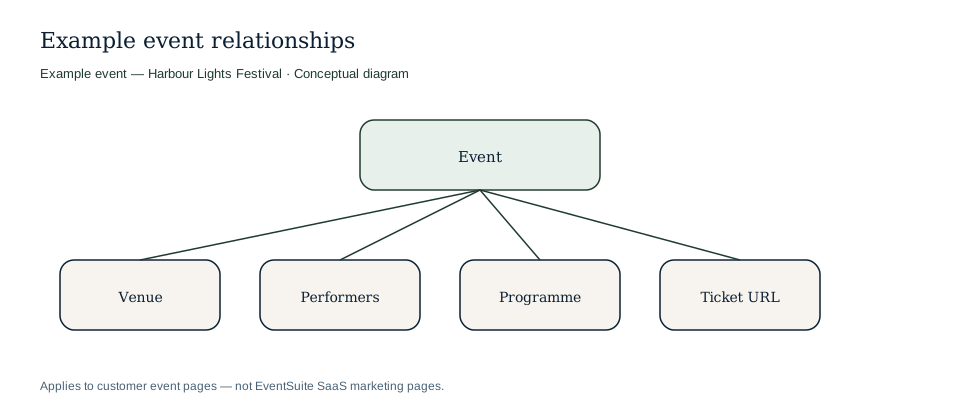
Example event relationships for Harbour Lights Festival.
Example output
Shortened example derived from the product’s Event-oriented relationship model for a fictional festival.
{
  "@type": "Event",
  "name": "Harbour Lights Festival",
  "startDate": "2026-08-14",
  "location": { "@type": "Place", "name": "Harbour Quay" },
  "organizer": { "@type": "Organization", "name": "Harbour Lights CIC" },
  "offers": { "@type": "Offer", "url": "https://tickets.example/harbour-lights" },
  "performer": [{ "@type": "Person", "name": "Maya North" }]
}
Customer event pages
Event schema belongs on the organiser’s published event pages.
SaaS marketing pages
EventSuite marketing pages do not use Event rich-result schema.
Example only — customer event pages, not EventSuite SaaS marketing pages.
Structured data is most useful when it represents the same information people can read on the page. Event Growth Studio starts from approved event content and canonical facts, then supports machine-readable representation where it is relevant.
Example only: these inputs apply to customer event pages. SaaS marketing pages like this one explain the product; they are not themselves customer Event rich-result schema.
| Approved customer event content | Structured relationship supported | Human review check |
|---|---|---|
| Festival runs 18-20 July at North Pier Hall. | Event date range and venue relationship. | Confirm date, time zone, location and public visibility. |
| Standard ticket and workshop add-on are sold through the official ticketing system. | Offer or ticket-related context where appropriate. | Check price, availability and checkout URL remain authoritative in ticketing. |
| Keynote speaker profile and Saturday session page are approved. | Person, programme and session relationships. | Confirm biography, role, schedule and permission to publish. |
Approved customer event content
Festival runs 18-20 July at North Pier Hall.
Structured relationship supported
Event date range and venue relationship.
Human review check
Confirm date, time zone, location and public visibility.
Approved customer event content
Standard ticket and workshop add-on are sold through the official ticketing system.
Structured relationship supported
Offer or ticket-related context where appropriate.
Human review check
Check price, availability and checkout URL remain authoritative in ticketing.
Approved customer event content
Keynote speaker profile and Saturday session page are approved.
Structured relationship supported
Person, programme and session relationships.
Human review check
Confirm biography, role, schedule and permission to publish.
The right structured data depends on the actual event content, not a generic checklist.
Identify the event, organiser, dates, location context and official event relationships.
Connect venue information, access guidance, travel notes and visitor-supporting pages when approved.
Represent ticket-related information from canonical facts while official ticketing remains authoritative for purchase.
Describe schedules, sessions, performers, speakers, activities and related pages where those entities exist.
This marketing page can describe the capability, but the product helps customer event pages represent their own event facts.
More markup is not automatically better if the event content does not support it.
Identify which system or owner controls dates, venue, ticketing, programme and organiser facts.
Place facts in structured event sections so people can read and review them.
Use the approved content to support relevant machine-readable entities and relationships.
People approve the page and supporting structured data; AI never publishes on its own.
Changed schedules, locations or ticket details return to source review before updates go live.
Machine-readable event information must stay aligned with the official event experience.
Explore connected Event Growth Studio workflows without leaving the creation and CMS cluster.
No. Structured data can help machines understand approved event information, but it does not guarantee rich results, rankings, AI citations, traffic or ticket sales.
No. Structured data should be selective and supported by the visible page content and approved sources.
They can be referenced from canonical ticket facts where appropriate, but official ticketing remains authoritative for prices, availability, checkout and orders.
Yes. The same approved content can support page sections, metadata, internal links, summaries, promotional outputs and structured data.
Your team reviews and approves the content and related structured data before publication. AI does not approve or publish changes.
Start with Event Growth Studio and the microsite so the event facts have a reviewed public home.
Use guided creation and Event SEO to keep content, metadata and structured data aligned as the guide grows.
Represent only the relationships the approved event content really supports.
Visible content first.
Selective schema, not forced markup.